
FAQ for Users
This page contains common questions relevant to Quran Central project only.
Re-uploading on Third-Party Platforms
Section titled “Re-uploading on Third-Party Platforms”This is one of our most common questions.
If you re-upload audio (for example to YouTube) and receive a copyright claim or strike, this is not handled by Muslim Central or Quran Central. These decisions are made by the platform and/or the copyright owner.
If you want permission to upload or reuse audio from our platforms, you must contact the original speaker, reciter, or rights holder directly and get their approval first. We cannot grant permission on their behalf.
What happens when I download audio?
Section titled “What happens when I download audio?”Both platforms are streaming-first. Downloads are for offline listening inside the app or browser, not for file distribution.
This means:
- Audio stays inside the official app/site experience
- Playback works offline
- Files are not exported to your device file system
- Content cannot be redistributed from in-app downloads
Where do my downloaded audio files go? (Android App & Web)
Section titled “Where do my downloaded audio files go? (Android App & Web)”Downloaded audio files are stored exclusively within Muslim Central or Quran Central (whichever app or web platform you use) and are not accessible through your phone’s file manager, other apps, or external devices.
This applies to:
- Muslim Central Android App
- Quran Central Android App
- Web App versions (on browser)
How downloads work:
- Downloads are accessible only within the official app or web platform for offline listening
- Audio files are not stored in your device’s file system
- You cannot transfer, export, or share downloaded files to other apps or devices
- This ensures content remains secure and within the intended environment
If you cannot find a download:
- Open the official Muslim Central or Quran Central app/website and check the Downloads section
- Ensure the download completed successfully
- Try re-downloading if the file appears corrupted
Downloaded content is exclusively for your personal, offline use within the official platform.
Why are some external podcast apps not supported?
Section titled “Why are some external podcast apps not supported?”We prioritize official platforms so we can keep content accurate, current, and responsibly managed. Some third-party platforms make this difficult.
Why is certain audio not available on Spotify?
Section titled “Why is certain audio not available on Spotify?”Spotify appears to remove some audio through its automated systems, which may incorrectly classify Qur’an-related content as music or flag it for similar reasons.
This has been an ongoing issue, and repeated attempts to resolve it have not led anywhere. If something is missing on Spotify, please use our web app or other official platforms instead.
Can I reupload or redistribute your audio?
Section titled “Can I reupload or redistribute your audio?”No. Audio remains the property of the original speakers or reciters. Personal listening is allowed; reuploading and redistribution are not.
Why might content change or be removed?
Section titled “Why might content change or be removed?”Content may change due to speaker/reciter requests, rights issues, quality corrections, or project curation decisions.
Why are you streaming-first?
Section titled “Why are you streaming-first?”Most platforms like ours is for listening, not file distribution.
A streaming-first approach allows us to:
- Correct errors or replace problematic recordings
- Respond to speaker or rights-holder requests
- Maintain a consistent and reliable library
- Sustain a free, ad-free platform
This model balances listener convenience with long-term responsibility.
Can you provide reciter contact details?
Section titled “Can you provide reciter contact details?”We cannot provide personal contact details.
Please check their official websites or verified social profiles.
Can you help with personal or family questions?
Section titled “Can you help with personal or family questions?”Not directly. Muslim Central is a content platform, not a personal counseling or fatwa service.
If you need guidance on family, parenting, marriage, or other personal matters, please speak to a trusted local imam, scholar, counselor, or community elder who can understand your situation properly and advise you responsibly.
What if I think a recitation contains an incorrect pronunciation?
Section titled “What if I think a recitation contains an incorrect pronunciation?”If you think there is a pronunciation issue, please review the support guidance before emailing us.
Listeners sometimes hear a different riwayah or simply misunderstand what was recited, so reports should include clear evidence and, where possible, confirmation from a qualified reciter or teacher.
How are reciters chosen?
Section titled “How are reciters chosen?”We use input from highly qualified teacher(s).
Why Is the Kasrah Sometimes Below the Shaddah and Sometimes Below the Letter?
Section titled “Why Is the Kasrah Sometimes Below the Shaddah and Sometimes Below the Letter?”This is a matter of typesetting and font design, not a change in pronunciation.
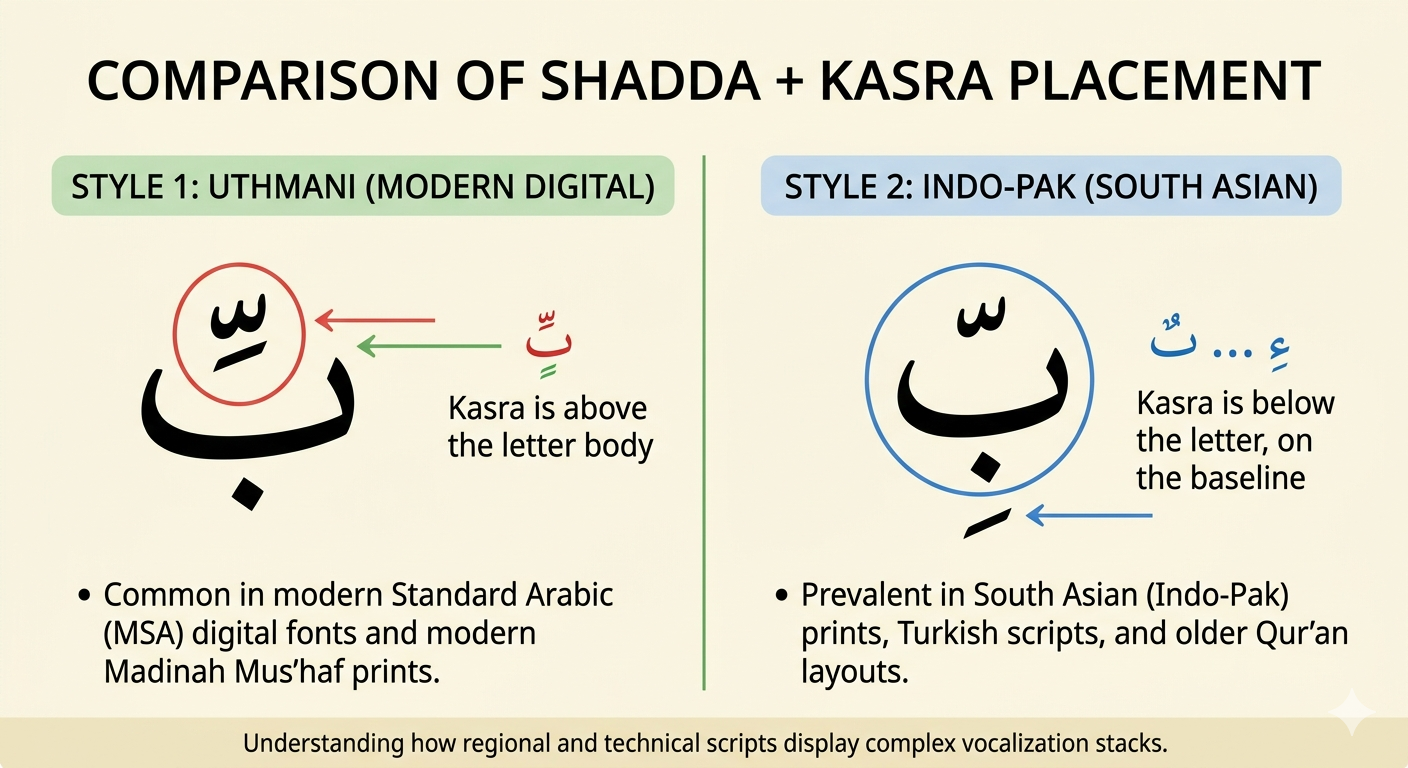
Some Qur’an fonts place the kasrah directly below the shaddah so the marks stay visually compact and avoid collisions with nearby signs.
Other fonts keep the kasrah below the base letter, which is a more literal placement for a kasrah.
Both layouts represent the same recitation: a doubled consonant because of the shaddah, together with a short i sound because of the kasrah.
Qur’an Recitation Styles – FAQ
Section titled “Qur’an Recitation Styles – FAQ”What is Tarteel?
Section titled “What is Tarteel?”Tarteel refers to reciting the Qur’ān slowly, clearly, and correctly, while fully observing the rules of Tajwīd.
This includes:
- Correct pronunciation (makhārij)
- Proper letter characteristics (ṣifāt)
- Appropriate elongations (madd)
Tarteel prioritizes clarity, accuracy, and reflection, rather than musical performance.
What recitation speeds fall under Tarteel?
Section titled “What recitation speeds fall under Tarteel?”Tarteel is an umbrella category that includes several commonly used recitation paces:
-
Murattal
Slow and clear recitation, ideal for learning, memorization, and contemplation. -
Muḥaḍḍar (Hadr)
Faster-paced recitation, often used for completing large portions (e.g. during Ramaḍān), while still observing Tajwīd. -
Tadwīr
A moderate pace that balances between slow and fast recitation.
All of these styles maintain correct Tajwīd without extended melodic embellishment.
What is Mujawwad?
Section titled “What is Mujawwad?”Mujawwad is a more ornamented and melodic style of Qur’ān recitation.
While Tajwīd rules are still fully observed, Mujawwad places additional emphasis on:
- Prolonged vowels (extended madd)
- Controlled melodic flow
- Vocal artistry and tonal variation
This style is commonly heard in:
- Formal public recitations
- Qur’ān competitions
- Stage or ceremonial performances
What is the main difference between Tarteel and Mujawwad?
Section titled “What is the main difference between Tarteel and Mujawwad?”The key difference lies in purpose and delivery:
- Tarteel focuses on clarity, correctness, and ease of following along.
- Mujawwad emphasizes melodic expression and artistic delivery.
Both are valid forms of Qur’ān recitation, but they serve different contexts and listening needs.
Which recitation style is best for learning or memorization?
Section titled “Which recitation style is best for learning or memorization?”For most learners, Tarteel (especially Murattal) is recommended because:
- The pace is easier to follow
- Pronunciation is clear
- There is less melodic variation to distract from the words
Mujawwad is generally better suited for listening and appreciation rather than active memorization.
Does Mujawwad replace Tarteel?
Section titled “Does Mujawwad replace Tarteel?”No. Mujawwad does not replace Tarteel.
Tarteel is the foundational approach to Qur’ān recitation, while Mujawwad is a specialized, performance-oriented style built upon that foundation.
Why do you categorize recitations this way?
Section titled “Why do you categorize recitations this way?”These categories help listeners:
- Understand what style they are listening to
- Choose recitations suited to learning, reflection, or listening preference
- Maintain clarity between standard recitation and melodic performance styles
The goal is educational clarity, not restriction.